1845
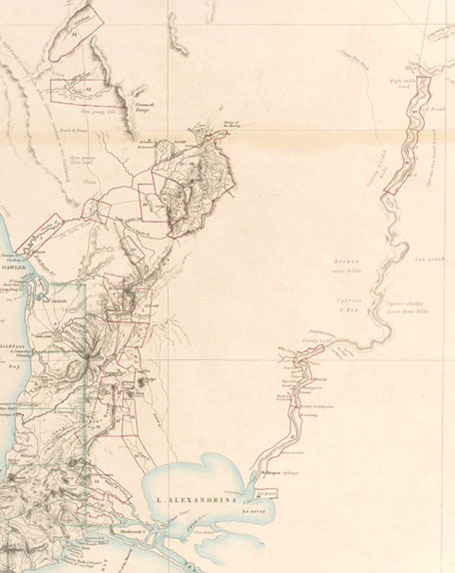
August. Shepherds William Streair and Thomas Pickett discover outcrops of copper close to the Burra Burra Creek. Special Survey of 20,000 acres undertaken and divided between South Australian Mining Association and Princess Royal Mining Association

Burra Creek Special Survey
September 29 - South Australian Mining Association (SAMA) begins mining operations at the Burra Burra Mine.
1846
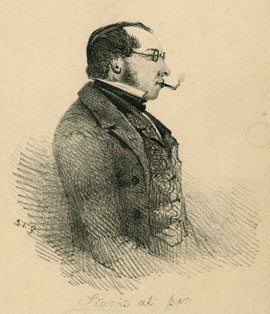
Samuel Stocks jnr. Appointed Resident Director.
Dr Ferdinand Von Sommer and then Captain Ey act as Superintendents.
Governor Robe visits and goes underground.
Bon Accord Mining Company begins mining operations adjoining the Burra Burra Mine.
1847
January. Captain Henry Roach of Cornwall appointed Superintendent of the Burra Burra Mine.
First smelting operations fail. [more]
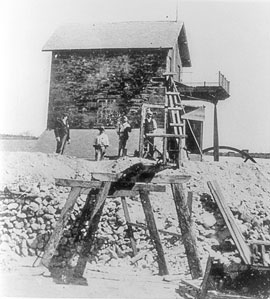
Powder Magazine constructed. (now the oldest surviving mine building in Australia)

Restored Powder Magazine, the Burra Mine
Built in 1847, it is said to be the oldest existing mine building in Australia. It held between 5 and 6 tons of gunpowder stored in barrels and was lined with sheepskins to prevent accidental sparks. The surrounding wall was added some years after construction of the original stone building
1848
Mine employs 567
Miners strike for a week and then later stage an unsuccessful strike over wages from November to January
1849
Mine pays a dividend of 600%
Foundation stone of Patent Copper Co. Smelters laid in December
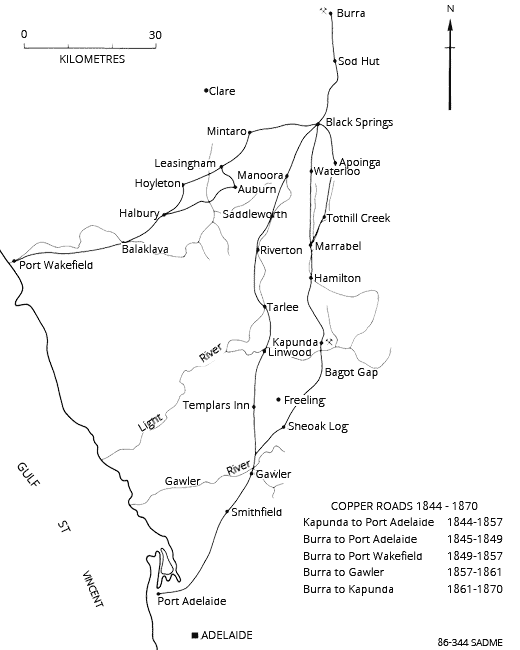
The Gulf Road [more] initiated to Port Wakefield.
The Gulf Road as it was known, connected a series of waterholes found at Gum Creek, Kadlunga, Skillogalee Creek, near Clare, Hoyleton, and Dunn’s Bridge at Balaklava for the bullock teams that hauled coal, copper and other materials between Burra and Port Wakefield at the head of the St. Vincent's Gulf.
Apoinga Smelter takes Burra ore
Patent Copper Company (later called the English & Australian Copper Company) begins smelting ore at Burra using Newcastle coal.
Roach's Engine House completed and pumping begins in October.
Dividends affected by 1848-49 strike: 2 of 100%.
1850
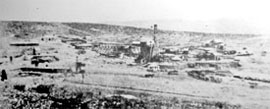
Burra Mine 1850
This very early callotype photograph of the Burra Mine, taken in 1850, shows the first engine house at the site. Roach’s engine was installed to pump ground water, discovered at the 20 fathom level, from the drives so that mining could continue. As the mine went deeper to 30 fathoms it soon became obvious that this pump engine could not cope with the flow of water into the mine and it was replaced with the more powerful Schneider’s pump engine in 1852.
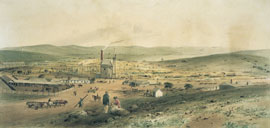
Burra Burra Mine Showing Main Portion of Surface Operations 10th February, 1850
From the original watercolour by S. T. Gill at the Burra Regional Art Gallery This panorama of the mine, facing towards the south west, shows a rather busy scene with Roach’s Pumping Engine-house and its flue, the main feature of the painting. The launder from this engine-house, supported on tall timber pylons, reaches towards the hill on the left, where the water is discharged into the engine pool. The large shears with Johnny Green, the mine mascot, and the Union Jack atop are clearly shown. A couple with their child is in the foreground and there are bullock teams pulling drays along a well-worn thoroughfare. Numerous horse whims[more] are visible with piles of ore accumulating nearby and the stables are fenced off from the rest of the mine. Far off on the hill to the left is the powder magazine. All seems very neat and orderly, too much so. Donated by the Hon. John Lewis MLC.
Dividends paid reached a staggering 800%.
1851
Workforce at the mine exceeds 1,000 with 378 at the smelting works and other off-site employees of the smelting works brings their total to about 1,000 also.
Peacock's Engine House built.
Discovery of gold in eastern states.
Patent Copper Co. reorganised as English and Australian Copper Co.
November - Death of the discoverer of the Burra Burra Mine, shepherd Thomas Pickett [more] who by now was a timber [more] carter for the smelter.
1852
Miners etc. desert the district for Victoria.
Schneider's Engine transported to Burra and installed
Employees drop to under 100.
Mining company secretary Henry Ayers keeps his officers by substantially raising salaries.
Pumping ceases in October: mine flooded.
1853
Mine virtually at a standstill
Roach's Engine House dismantled
English and Australian Copper Company import mules from South America.
1854
Men slowly return but by April work force still only 191 and only 30 underground.
Decision to restart the mine in December.
1855
Schneider's Engine begins to pump out the mine in January.
1856
South Australian Mining Association establishes a candle factory near the slaughterhouse to satisfy its need for 53 tons of candles per year.
1857
Schneider's pump proves inadequate.
Railway reaches Gawler.
The Gulf Road closes.
1858
Peacock’s Winding Engine-house in 1901.
Known by the miners as the ‘fire whim’; steam power replacing horses, it operated from 1858 until the closure of the mine in 1877. Its engine is still in place at this stage. Note the mine captains’ cottages and the mine offices in the background. Its stone flue was dismantled in 1971 and now stands at the entrance to the mine.
Morphett's Engine House built.
William Woollacott leaves Adelaide with the engine for Morphett's Engine House.
1859
This was the peak year for employment with 1208 men and boys at work. The mine paid £178,900 in wages and expenses, but the costs were rising as the mine deepened. At the same time the price of copper was falling. Having peaked at £126 per ton in 1858, it was £112 per ton in 1859 and by 1861 had fallen to £87 per ton in Adelaide. Even more significantly the 1858 profit per ton of £4-8-3 was a mere £1-14-8 the following year.
Ayers reduced the wages of tutworkers to 6/- a day and cut all but essential tutwork. Similar cuts in payments were ordered for tributors. Expenditure of repairs etc. was cut to a minimum.
William Woollacott arrives with the new engine.
Installation of Morphett’s Engine runs all through the year.
The wage bill peaks at £178,900.
Employment at the mine exceeds 1,200
Profits per ton begin to fall
1860
Miners begin to move to the new Yorke Peninsula fields of Wallaroo and Moonta Mines.
Morphett's engine begins pumping on 1 March
Fire in the mine kills two miners
1861
Morphett’s Winding Engine House c1890s
Built in 1861, this stone half house held a 26HP rotative beam engine that hauled kibbles to the surface from Hector’s Shaft at the Burra Mine.
Migration to Wallaroo and Moonta continues and others also head to mines in Queensland and NSW as well as to smaller mines north of Burra in the Flinders Ranges etc.
Port Adelaide Smelting Works begin.
Burra Smelting confined to summer months.
1862
Schneider's Engine is stopped.
Workforce at the mine is cut to 631 and the wages bill is almost halved.
Exodus of miners continues
1863
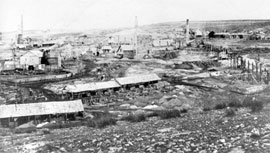
This panorama of the Burra Mine taken in about 1863, shows some of the many sheds, in the foreground, where the ore was sorted by ton workers before it was taken to the smelter. What is particularly significant, because it dates the photograph, is one of the few images of Schneider’s Engine-house at the centre of the picture. It is shown here without its shears and roof and its engine removed. Alongside is its boiler-house and on the skyline behind is its flue. In the background on the far left are Morphett’s Engine-houses and to the right is Peacock’s Winding Engine-house with a row of poles carrying the hauling cable to two shafts at the far right-hand side of the picture.
The Burra ore was still averaging 23% copper compared with Moonta's 18%, but getting it was costing £10-2-1 per ton against £7-15-7 for the latter's.
SAMA was pulling down cottages when their tenants departed.
Kooringa was still all leasehold and there were few businesses in substantial premises.
Trouble looms as Burra ore now cost £10-2-1 per ton to raise compared with £4-15-7 a ton at Moonta.
1864
For a while copper rose to £110 per ton and a major strike at the Yorke Peninsula mines saw some miners return to Burra.
Smelting at Burra further reduced.
The dividend of 300% proves to be the last regular dividend paid.
1865
By July SAMA was losing £800-£I,000 per month. The population of the combined towns was still about 4,000, by which time Moonta had reached 4,000 and the three Yorke Peninsula towns had about 10,000 people in all.
Yorke Peninsula mines continue to grow and outflow of Burra's population continues.
1866
The copper price slumps by £8 per ton. On 19 February Ayers informs Captain Roach that all operations would cease and a letter dismisses all officers from the end of March.
1867
1867 became a year of desperation with mass unemployment in Burra and Adelaide. There was no unemployment relief except for a meager ration for families without an able bodied man in residence. Though wages had been cut to a low 6/- a day, Ayers thought 4/- a day would be adequate. In Burra people left, cottages were demolished and shops and businesses were abandoned. To make matters worse the wool producers were in the grip of a drought, which extended from 1864 to September 1869 on the eastern plains.
In fact, bad as it was, the situation was not quite as bad as the original notice had suggested. By the middle of the year the mine was still employing about 200 to dress low-grade ore previously discarded, but Captain Roach had returned to Adelaide and the accountant Mr. Challoner was running the mine on orders from Ayers. The mine was maintained on standby with the pump at Morphett's Shaft still keeping the mine free of water. Grave's Engine House was under construction with a new pump ordered from Cornwall.
Graves Shaft Burra Mine still employing over 600 and population of town almost 4000.
Underground mining suspended in February with the loss of over 500 jobs.
Captain Roach, William Challoner (Mine Accountant) and William Elphick (Mine assayer) given 1 month's notice.
Parliament approves extension of railway to Burra.
1868
John Darlington, a mining engineer with extensive experience of the then new open-cut mining system, arrived in Adelaide in June and the following month went to Burra to assess its open-cut prospects. He found a mine in soft clayey ground that needed extensive and costly timbering. In September he recommended trying open-cut mining as an economic alternative. Ayers and three directors: G.S. Kingston, John Beck and Archibald Jaffery, went to Burra and accepted the recommendation.
Grave's engine House completed but the engine order was cancelled. The building was never used.
The decision was made to convert to open cut.
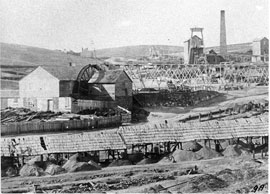
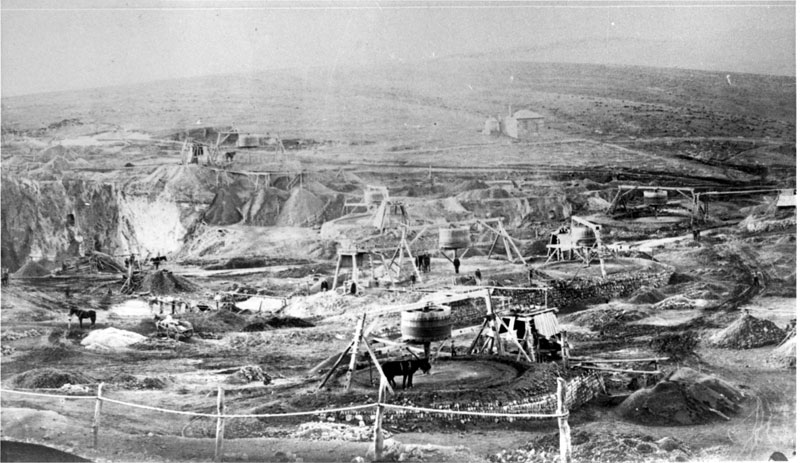
This photograph of the mine taken in 1869 shows the launder that conveyed water to the giant waterwheel that powered the sawmill and the ore crusher. Note the timber in the fenced yard adjacent the mill. In the background on the right are Morphett’s Engine-houses and the tall flue that served the six Cornish boilers. In the foreground are the ore dressing sheds. The poppet-head above Hector’s Shaft is visible behind and to the left of Morphett’s Pump-house.
1869
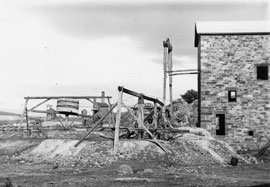
Built from the stone of Schneider’s engine-house, Graves’ Engine-house was completed in 1869 immediately prior to the decision to go to open-cut mining The horse-whim on the left and the capstan, in the foreground were used to haul mullock from Graves’ Shaft as it was sunk to join up with drives in the body of the mine. A dark steel kibble can be seen hanging from the poppet-head above the shaft, another is on the far right.
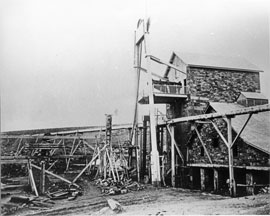
Morphett’s Pumping Engine-house 1869
The huge 32 ton beam can clearly be seen protruding from between the balconies and the giant shears with its wheel towering above. The boiler-house that held six Cornish boilers producing steam for both of Morphett’s beam engines is still intact. The launder that delivered the mine water to the crusher’s waterwheel runs to the left and to the right to Morphett’s Pool. The pump engine is idle awaiting a decision on the future of the mine; one that would see it become an open-cut mine. Note the small poppet-head straddling the shaft, which was replaced by a larger one for the installation of the 20 inch risers during the later stages of the mine. When the mine ceased in 1877 the beam was left slanting downwards, not level as seen here.
Work on the waste from the mine in the Burra Creek stopped and a further 200 jobs went. By April all extraction work had ceased. A 363 ton stockpile was sold off and by October the workforce had fallen from 1,200 to 46. (11 mechanics, 19 miners, 7 labourers, 4 boys and 5 officers.) Wages fell from £130,000 per annum to just £1,313-6-8 for the six months to March 1870. The Burra population fell from c.5,480 to 3,400 and occupied houses from 1225 to 877.
The year largely passed in ordering and obtaining the necessary machinery.
In April in its 24th Annual Report SAMA decided to make properties in Kooringa available for freehold sale as their 21 year leases expired.
1870
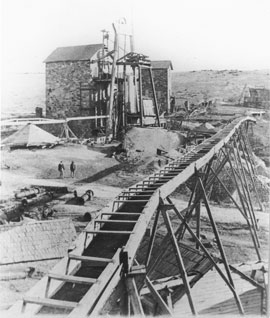
Morphett’s Pumping Engine-house with Morphett’s Winding Engine-house behind c1900.
Note the engine and beam are still in place at this stage as are the shears and large poppet-head above Morphett’s Shaft. In the foreground is the launder that carried water from Morphett’s Pool to the dressing tower during the open-cut operations of the 1870s. In the foreground are some of the numerous sheds with shingled roofs that grew up throughout the mine.
In January Henry Ayers left with his family for England and his son, 25 year old Harry Lockett Ayers, became Acting Secretary of SAMA. William Challoner continued as chief accountant and superintendent of the mine. (At £32 per month) William Swansborough was retained as supervisor of the open-cut operations. (At £25 per month) By June operations at the open-cut were underway and good results were expected.
By October 10,000 wagons, or 14,000 tons had been excavated and sent to the tip some 100 feet beyond the dressing tower and dressing was expected to begin in six weeks. The arrangements had cost some £25,000.
Open cutting of Burra Burra Mine began, Australia's first open-cut mine. The timber recovered from the old workings during the operations of the open-cut was used to fuel the pump engine and the water was used to separate the ore from the waste after it had been pounded to the consistency of flour.
1871
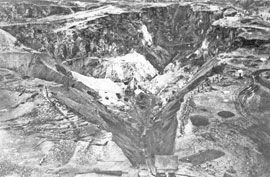
This photograph of the open-cut mining operation in the 1870s shows a truck being hauled up the steep inclined railway from the workings below. Peacock’s engine performed this operation initially but it was later replaced with another hauling engine.
By the middle of the year friction between Challoner and Swansborough saw Challoner confirmed as the superior officer, but poor results saw him being asked to resign by October. After 25 years service as accountant and two as mine manager SAMA was not even represented at his farewell dinner in Burra in December. As far as getting material out of the open-cut was concerned all was going well.
The Ulooloo goldfield was discovered
1872
The problems that began to worry the directors were multiplying.
(a) Little orey stuff was being discovered by October. The previous six months had produced only 6,974 tons of orey stuff to 37,174 tons of attle (waste).
(b) Morphett's Shaft was producing 96,000 gallons of water per hour, but this was proving inadequate for washing the amount of ore and new 20inch lifts had to be installed.
(c) The new dressing tower proved unsatisfactory and the old stamps had to be reintroduced. A new 15 head battery was ordered.
(d) Dressing machinery tried at Moonta with success was tried, but the Burra ores proved very hard to separate from their waste.
The receipts on ore raised were £10,426
Receipts from rent were £2,024
Giving an Income of £12,450
Expenses were £13,661
The Overall loss was £1,211
The first dividend since 1864 was paid from accumulated funds and proved to be the last before the mine closed.
1873
To assist in the dressing operations a new 24 feet x 4 feet water wheel was constructed. The failure of the dressing machinery to deliver satisfaction saw Captain Robert Sanders take over from Swansborough. As the water level dropped to the 40 fathom (73 metres) and then the 50 fathom (91 metres) level, some underground work was resumed. Small profits made 1873-76 went into capital investment in new machinery.
1876
By this time tutworkers were sinking new shafts, deepening old ones and driving new levels.
39 tributors were at work and they raised 254 tons of good ore. By October the workforce was back to 307 of which 102 were in the traditional categories of tutworkers and tributors. Haulage from the open-cut continued to be satisfactory, but ore separation remained a difficulty. Six months in this year saw the open-cut yield 22,790 tons of deads, 26,382 tons of orey stuff and 1,156 tons of old timber.
Captain Sanders reports remained consistently optimistic, but in fact no new lodes of significance were being discovered.
1877
Morphett's Shaft was being pushed towards 100 fathoms, with drives at different levels in an attempt to find new lodes, but to no avail. The cost of production had risen so that the mine was losing £12-17-0 on each ton of ore. The cost of production had almost doubled since 1868. The price of copper was low and dropped to less than £80 a ton.
In August the five SAMA directors: Sir George Strickland Kingston, John Beck, Henry Rymill, The Hon. William Morgan MLC, and James Francis Wigley, visited the mine. After this Sir Henry Ayers, secretary, wrote to Captain Sanders instructing extreme economy or the closure of the mine would be considered. Economies had no answer in the face of rising production costs and a falling copper price.
In September the miners were finally given a week's notice and work ceased on 29 September 1877 with the loss of 300 jobs.
The exploratory work in Morphett's Shaft had just reached 100 fathoms. The mine officers received one month's notice, Captain Sanders being dismissed with all the others.
About the 10 October there was a final inspection at the bottom of Morphett's Shaft by Captain Osborne, Manager of Kapunda Mine, Captain Samuel Higgs, Manager of Wallaroo Mine and Captain Hancock, Superintendent of Moonta Mine. Their reports were non-committal.
The pump at Morphett's Shaft was stopped in the last week of October and the waters began to rise in the mine.
The mine was put into mothballs to be reopened when copper prices rose, but the sale of plant and equipment in November made it clear that the directors did not expect this to be any time soon.
September 29 - Burra Burra Mine closed after 32 years.
1880
The lode found when St. Mary's Church of England foundations were dug is briefly searched for.
1881
News that the Mine had been sold in England for £100,000 proved to be false.
1882
Captain Killicoat and John Drew unsuccessfully negotiate to buy the Mine.
1884
Negotiations with a Sydney syndicate are reported.
1886
Two tributors are working a surface pitch.
1887
Two tributors are making wages.
1888
A local syndicate involving C. Drew, J. Dunstan Jun., E.C. Lockyer, W.R. Ridgway & F.W. Holder negotiate to buy the Mine. They are told nothing can be done as the mine is under offer in London. Tributors now number 34 men and boys and rising. In December Sir Henry Ayers advises the mine has been sold in London to the Copper Syndicate.
1889
The Copper Syndicate fails, copper falls to £40 per ton, settlement of the sale on 13 March fails to take place.
Numbers working on tribute fall to "several".
1890
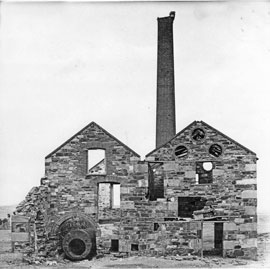
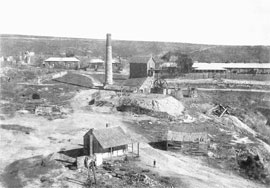
Ruins of the boiler-house at the Burra Smelter 1890s
The boiler supplied steam for a small engine that powered a crusher and sawmill.
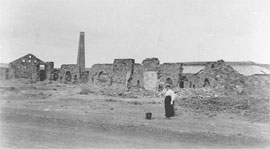
Ruins of the Burra Smelting Works 1890s
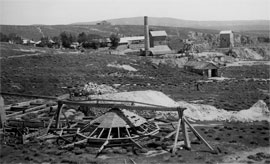
The boiler-house is on the far left of the picture with the ruins of stonework housing the furnaces running from left to right. The 80 foot brick chimney is in the distance. The smelting equipment was removed from the buildings shortly after its closure in 1869. All the ore was then taken via Kapunda to Port Adelaide to be smelted there. The stone was removed over the next twenty five years and used for other buildings throughout Burra.
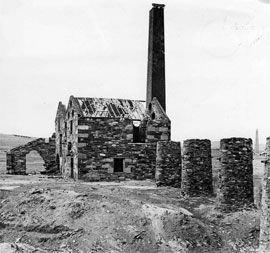
Burra Smelter Ruins 1890s
The brick chimney that served the crusher boilerhouse of the Burra Smelter up until its closure in 1869 dominates this scene. The remains of the flues for the first smelting retorts are shown on the right. These retorts or reverberatory furnaces used charcoal or coal* burning in a firebox with air drawn through the fuel producing hot gases that passed over the ore held in a separate chamber or hearth, reducing it to molten copper. The waste gases passed up these flues. An even larger 80 foot brick smelts chimney can just be seen on the right-hand edge of this photo. *At first this coal came from Wales or other British coal mines, but in 1854 it was decided to use coal from Newcastle in NSW.
About 9 tributors work surface material.
1891
Mr Paynter installs equipment to treat the slagheap. Work begins in October.
1892
Copper prices fall and in February Mr. Paynter stops crushing and by April his plant is for sale.
SAMA launches litigation related to the failed sale of 1889.
1897
SAMA decides on some exploratory boring which begins in November under Mr. Leahy.
1898
Boring at Morphett's shaft exceeds 1000 feet.
1899
Tributors continue to work at the mine. Mr Leahy sinks a second shaft but boring ceases in November.
Joe Ford secures a portion of the site and sinks a shaft.
Copper at £75 per ton. Hon. J. Martin MLC of Gawler backs the Burra Slag Extraction Co which take an 8 year lease to treat the slag. Trial crushings are unde way by November.
1900
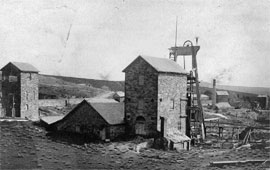
Morphett’s Pumping Engine-house in about 1900, well after the closure of the mine.
There are three other engine-houses in this picture; Morphett’s Winding Engine-house on the far left, Peacock’s Engine-house with its flue and to the far right Graves’ Engine-house. Note all the roofs are still intact, even the roof of the boiler-house abutting its engine-house. The small building immediately to the right of Morphett’s engine-house is an engineer’s workshop with a forge. The stone wall of Morphett’s engine pool is seen on the hillside to the right of Morphett’s Winding Engine-house.
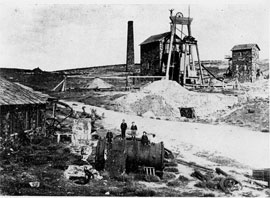
Burra Mine Site c1900
In the centre foreground lies the cylinder of Schneider’s engine. It had been removed from its engine-house in 1863 and left to rust away within sight of Morphett’s Engine-houses, the engines that had replaced it. For two years prior it had shared the pumping duties with Morphett’s engine, but its stone was needed for building Graves’ Engine-house.
An Adelaide based syndicate begins negotiations to buy the mine.
In January the Burra Slag Extraction Co. Installs electric arc lights and works three shifts.
1901
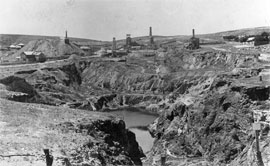
Burra Mine 1901
At the turn of the 20th Century the Burra Mine stood idle with the scars of the open-cut mining clearly visible. The water had risen to its natural level, creating a deep pool that was used by the locals as a swimming pool. The waterwheel on the left no longer supplied with water, its launder having been dismantled long ago. The piled up waste near what had been the dressing tower with its flue on the hill. The abandoned engine-houses, silent sentinels, looking down upon an alien landscape
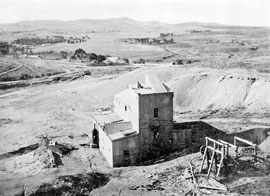
The ruin of the Electro-magnetic Extraction Plant, used to treat the mine tailings at the Burra Mine 1901-1904
The Adelaide syndicate leads to floating of the Burra Burra Copper Co., which buys the Mine. In March the Premier, F. W. Holder, and other politicians visit the works.
1902
Burra Slag Extraction Co. closes for a month due to low copper prices. Work resumes in February, ceases briefly in May but then goes on till all the slag is treated by the end of October.
Burra Burra Copper Co. lacks developmental capital. It hopes to accumulate capital from royalties from Elder, Smith and F. H. Snow's Electro-magnetic, Separation Co. which would treat tailings at the Mine.
1903
Burra Burra Copper Co. doing very little: employing about 7 miners. Electro Magnetic Separation Co. begins work in July after many problems.
In December Burra Burra Copper Co. calls tenders for a shaft at Bunce's.
1904
By February the Electro-Magnetic process has failed. By May the plant was being demolished and so was the Burra Slag Extraction Co. plant.
Burra Burra Copper Co. was employing about 22 men at various sites but most work was at a shaft near Peacocks air shaft. Several tributors continue to work pitches but with little success.
1905
Burra Burra Copper Company lacks the funds to dewater the mine A public meeting urges Government aid. The Government agrees to send a pump from Sliding Rock. In May the Directors advises the mine was under offer to a London Company.
In November C.A. Smith & Co. contract to lower the water 25 to 50ft.
1906
Pumping finally begins in May and the pool level drops 8 to 10 feet but falling share prices for Burra Burra Copper Company show a public lack of confidence. Copper reaches £90 per ton and then £100+.
1907
In January the negotiations with an Adelaide-Melbourne syndicate fail. Pumping ceases. Some tributors continue.
The Burra Copper Slag Smelting Co. bring in a smelter from Leigh Creek in January to re-smelt the slag from the Burra Slag Extraction Co. It begins in April, has problems in May and is abandoned in June.
Mr Horn takes an option on the Mine to run to 13 May and later he takes a one sixth interest in Great Fingall Consolidated and a five sixth interest in a 9 month option.
As a consequence more exploratory boring is undertaken but copper prices began to fall to about £66 per ton in September.
1908
The Kooringa Prospecting Syndicate (Great Fingall and Horn etc) decide by February that the 4 bores produced little suggestion of success and with copper at £61 per ton decide not to produce.
1909-1911
Tributors in small numbers operate in the mine and some along the creek working tailings and waste.
1912
The old mine owners, South Australian Mining Association in liquidation, sell off about 20 lots of the remaining properties in and around Kooringa and Graham.
1913
A further SAMA sale of all remaining properties in and around the town.
1916
Burra Burra Copper Company in January sells its Burra Mine properties. After the auction the Mine block itself is sold to A. J. McBride for £3000 for 262 acres. It is expected the tailings will be treated. Experiments to treat tailings by the du Faur process are undertaken.
1917
English and Australian Copper Co. sells its holdings in Burra in six lots in April.
1921
Chimney stack for Morphett's Engine House blown up for building stone.
1922
Further tests by du Faur on treatment of tailings.
1925
Morphett's Engine House, shaft etc. destroyed by fire by young boys smoking out rabbits.
1971

The end of Peacock’s Engine House 1971
In 1970 a modern open-cut mining operation commenced and this engine house had to be demolished. Peacock’s Chimney had been moved stone by stone to the entrance to the Burra Mine site where it stands today.
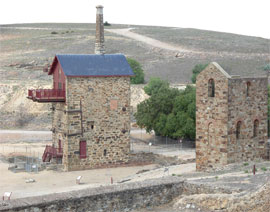
Morphett’s Engine-houses in 2007 with stone wall of Morphett’s engine pool in the foreground.
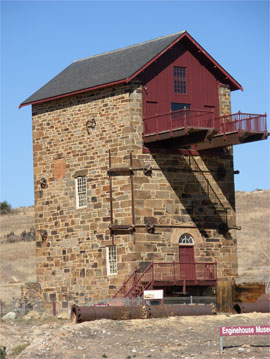
Morphett’s Pumping Engine House, 2009 The timber balconies and the slate roof had been restored and the building reopened to the public.